What Does a Heated Driveway or Patio Cost in Colorado?
2026 Colorado snowmelt planning bands for heated drives, walks, steps, and patios, including utilities, controls, paving, drainage, and operations.
Contractor-informedSources and limits visibleMethodology →
Direct answer
For estate planning in 2026, the Registry uses broad working bands of $35,000–$80,000 for targeted heated steps, walks, or a compact terrace; $80,000–$250,000 for a major patio, approach, or selected drive zone; and $250,000–$600,000+ for a large motor court, long drive, or multi-zone snowmelt system with major utility, paving, drainage, and control work. These are scope bands—not bids, per-square-foot promises, or operating-cost estimates.
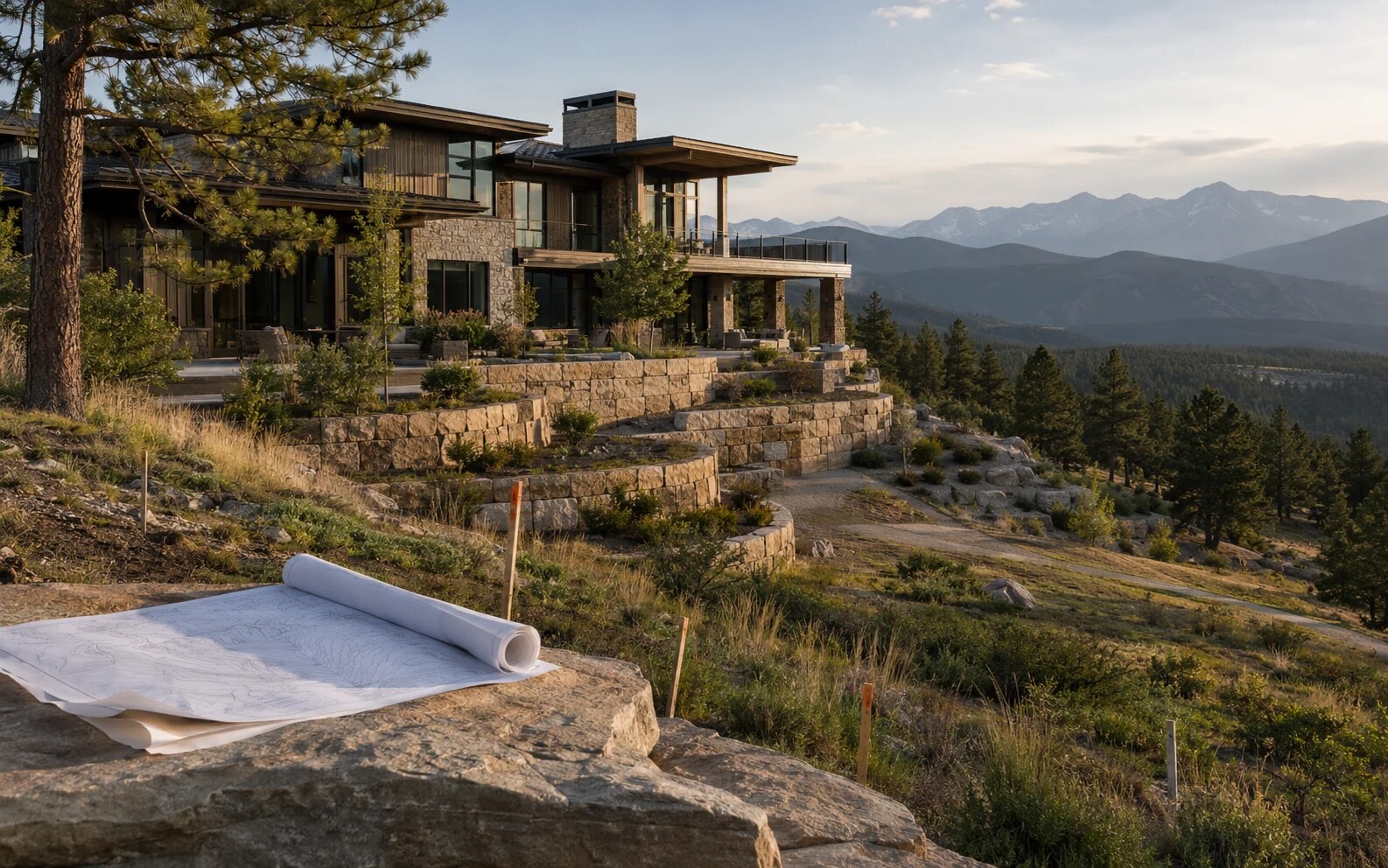
Illustrative planning context—not a completed Registry project or evidence of a quoted cost.
2026 Registry planning framework
How much of the estate should be actively melted?
The correct system is often selective. Protect the highest-risk circulation and service zones before heating every paved surface.
Planning band or model
Scope level
What the level must carry
$35K–$80K
Targeted safety zone
Steps, entry walk, compact terrace, or critical transition with defined hydronic or electric system, controls, and surface replacement.
$80K–$250K
Major patio or vehicle approach
Larger zone with distribution, plant or electrical capacity, sensors, drainage, paving assembly, controls, and commissioning.
$250K–$600K+
Estate-scale multi-zone system
Large motor court, long drive, complex grades, multiple manifolds or controls, utility upgrades, extensive paving, drainage, and staged operation.
These are Registry editorial planning bands or delivery models—not quotes, bids, appraisals, contractor surveys, or guarantees. Scope and property conditions govern.
01
What is included in a complete snowmelt system?
A complete plan can include energy source and capacity, boiler or electrical infrastructure, pumps, heat exchanger, manifolds, tubing or cable, insulation where specified, sensors, controls, paving assembly, drainage, access, flushing or testing, commissioning, controls integration, documentation, and surface restoration.
02
What moves the cost most?
Heated area, energy source, utility capacity, distance to plant, zoning, paving material, demolition, excavation, insulation, slab or setting assembly, drainage, controls, difficult access, freeze protection, and whether the project is new construction or retrofit drive the range.
03
How should operating cost be evaluated?
Ask the designer to model the actual heated area, output, climate assumptions, control strategy, energy source, standby behavior, melt objective, and expected run hours. A universal monthly estimate is not credible without those inputs.
04
What should be commissioned?
Verify pressure or electrical tests before concealment, sensor operation, zone control, flow or load balance, slab response, high-limit and fault behavior, manual override, shutdown, drainage, glycol or fluid requirements, labeling, as-builts, and owner training.
Direct owner answers
Frequently asked questions.
Should an entire Colorado driveway be heated?
Not automatically. Many estates gain more value by prioritizing steep approaches, shaded or icy transitions, entries, steps, service zones, and critical circulation while using plowing or manual treatment elsewhere.
Is hydronic or electric snowmelt better?
Neither is universally better. Area, energy source, utility capacity, response, zoning, operating strategy, service access, and life-cycle cost should determine the system.
Evidence and limitations
What supports this record?
Official sources support regulatory or technical context. The Registry's planning bands are labeled editorial judgments and are not attributed to public agencies.