Before approval
Questions the project team should answer.
- Who accepts the substrate?
- How is continuity tested and documented?
- Who protects the completed membrane from following trades?
- Where does water go after it reaches the drainage layer?
Colorado exterior material comparison · Reviewed August 2026
Compare sheet and liquid-applied waterproofing for Colorado terraces, planters, walls, decks, water features, and below-grade outdoor structures.
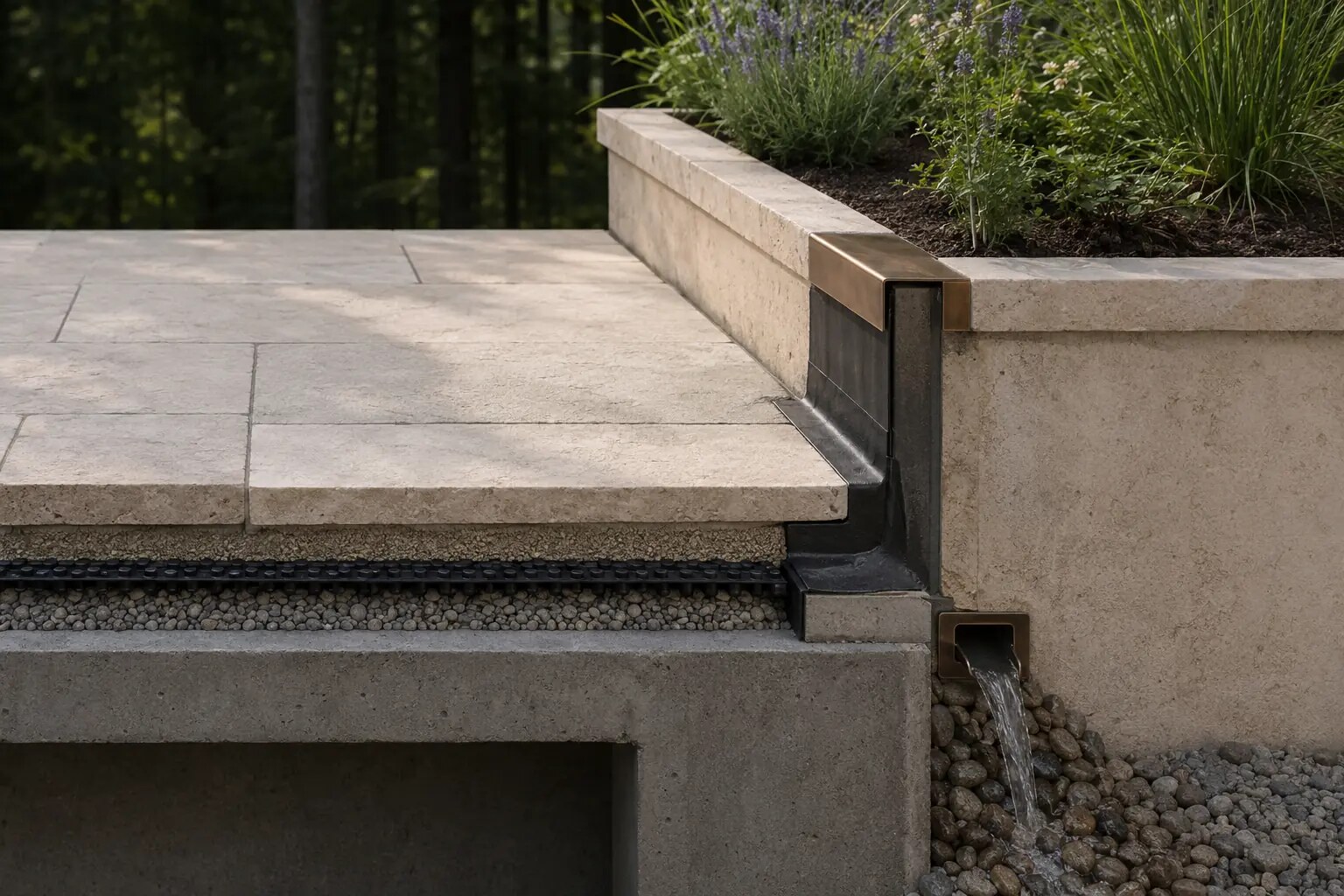
Sheet membranes offer controlled factory thickness but depend on seams, corners, penetrations, and terminations. Liquid-applied membranes can conform to complex geometry but depend on substrate condition, primer, reinforcement, weather, cure, and measured film thickness. The better system is the manufacturer-approved complete assembly whose transitions, drainage, testing, protection, documentation, and repair plan match the project.
Alternative-by-alternative
These are planning distinctions. Verify the exact source, product, finish, assembly, exposure, installer, and warranty.
| Option | Potential fit | Highest-attention questions |
|---|---|---|
| Sheet membrane | Broad areas and assemblies where controlled thickness and repeatable seaming suit the geometry | Laps or welds, corners, penetrations, substrate, terminations, protection, and repair access. |
| Liquid-applied membrane | Complex shapes, penetrations, transitions, and field conditions suited to the selected chemistry | Substrate moisture, primer, reinforcement, wet and dry thickness, weather, cure, recoat, and protection. |
| Combined transition system | Assemblies where manufacturer-approved sheet and liquid components solve different zones | Compatibility, warranty, transition details, trade ownership, testing, and single-source accountability. |
Decision criteria
| Criterion | Comparison | Owner action |
|---|---|---|
| Geometry | Sheet favors planned laps; liquid can follow complex forms | Review every corner, drain, penetration, change in plane, and termination. |
| Quality record | Sheet needs seam records; liquid needs thickness and weather records | Require observations, tests, repairs, and concealment photographs. |
| Protection | Either can be damaged by following work | Define access, protection board, sequencing, inspection, and acceptance before concealment. |
| Drainage | Waterproofing is not drainage | Show collection, overflow, outlet, filtration, service access, and downstream discharge. |
Before approval
Specific records
Evidence boundary
These sources frame material-system behavior. They do not approve a product, assign the Registry's editorial comparison, or replace current manufacturer literature and project specifications.
Registry methodology →