Before approval
Verify the actual selection.
- Complete manufacturer assembly and compatible accessories
- Substrate acceptance and transition details
- Trade sequence and protection plan
- Testing method, repairs, photographs, warranty, and drainage outlet
Specific material planning profile
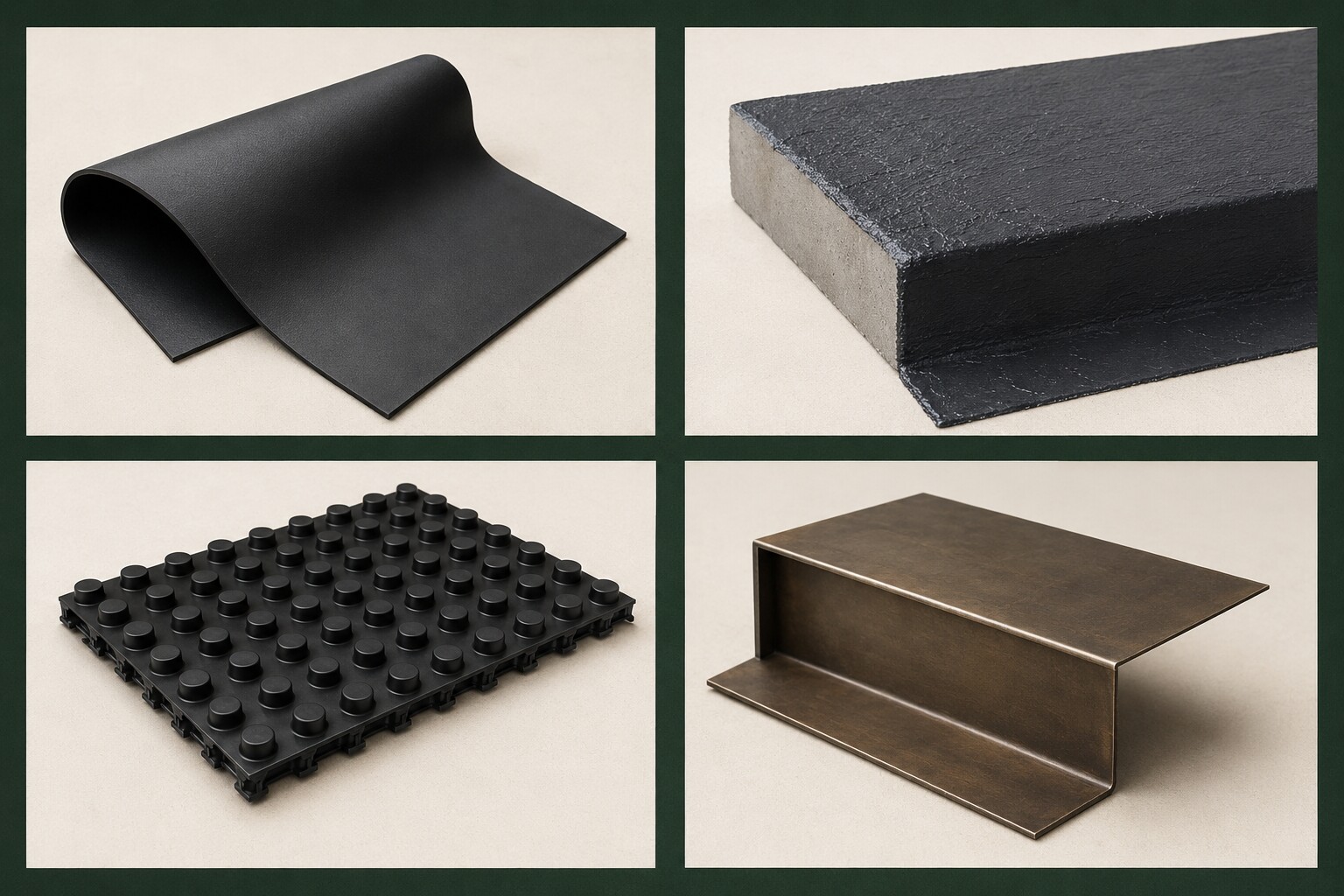
A factory-made waterproofing layer with controlled thickness, whose seams, corners, penetrations, terminations, substrate, protection, and testing form the real system.
How the five-point scale works
The Registry uses this scale to show how much project-specific specification attention a factor deserves for Sheet membrane. It is an editorial planning framework, not a laboratory result or product certification. No factors are averaged into an overall grade.
Levels are assigned from two questions: how consequential an unresolved factor could be, and how specific the evidence must be before commitment. They do not predict service life or failure.
Confirm the standard submittal and installation requirements.
Review the factor, but it is unlikely to control the decision by itself.
Give the factor explicit project-specific specification attention.
Resolve the factor before approval because it can materially affect the result.
Require source-, product-, exposure-, or assembly-specific confirmation before commitment.
Specification-attention profile
Every score below belongs to the named factor for Sheet membrane. It does not describe the other examples in waterproofing & drainage interfaces.
Continuity depends on laps, welds, corners, penetrations, drains, terminations, and compatible accessories.
Sharp edges, moisture, contamination, cracks, voids, and plane changes can compromise installation.
Following trades, reinforcement, pavers, soil, and traffic can damage completed work before it is covered.
Observed seams, testing, repair records, and concealment photographs are often the only durable quality record.
Before approval
Owner questions
Evidence and limits
These sources support the broader material-system principles. The five-point values are contractor-informed Registry editorial judgments under the published rubric; the sources do not assign those numbers. Current manufacturer literature, project specifications, source-specific test data, and local requirements must govern the actual selection.
Read the Registry methodology →