Specific material planning profile

Granite

A commonly dense crystalline stone family, still requiring product-specific review of finish, fabrication, joints, anchorage, and exposure.

Material category
Natural stone exterior systems
Common exterior uses
Paving, steps, coping, walls, counters, water features, and high-wear exterior details.
What is scored
Specification attention for this named material type—not quality, beauty, durability, or a particular product.
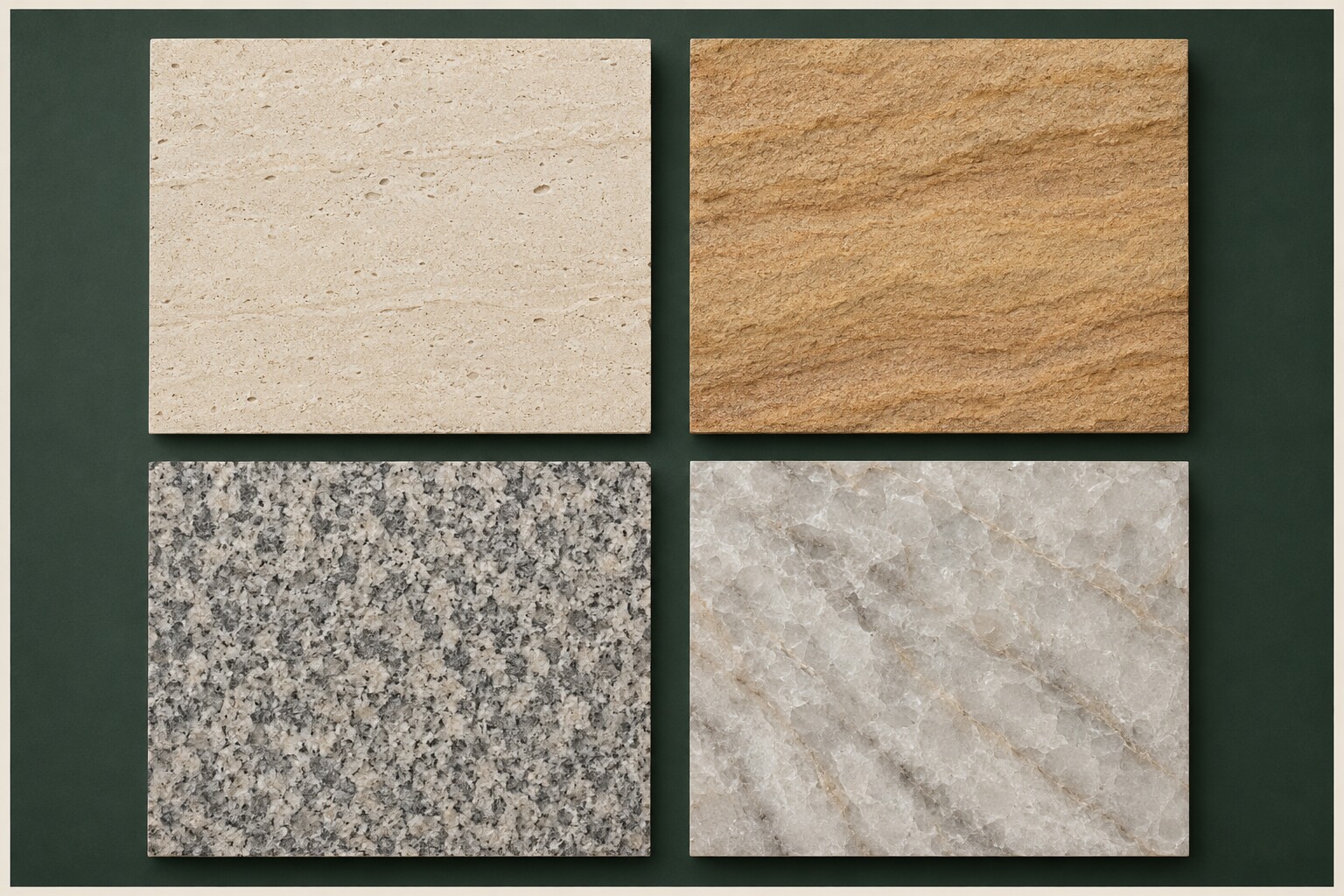
Illustrative Granite sample cropped from the natural stone exterior systems comparison board
Illustrative Granite study—not a named product, quarry, mill, approved finish, test specimen, or installed project.

How the five-point scale works

Higher means more confirmation—not better material.

The Registry uses this scale to show how much project-specific specification attention a factor deserves for Granite. It is an editorial planning framework, not a laboratory result or product certification. No factors are averaged into an overall grade.

Levels are assigned from two questions: how consequential an unresolved factor could be, and how specific the evidence must be before commitment. They do not predict service life or failure.

  1. 1Limited

    Confirm the standard submittal and installation requirements.

  2. 2Secondary

    Review the factor, but it is unlikely to control the decision by itself.

  3. 3Material

    Give the factor explicit project-specific specification attention.

  4. 4High

    Resolve the factor before approval because it can materially affect the result.

  5. 5Critical

    Require source-, product-, exposure-, or assembly-specific confirmation before commitment.

Specification-attention profile

What deserves attention for Granite.

Every score below belongs to the named factor for Granite. It does not describe the other examples in natural stone exterior systems.

  1. 4/ 5
    High attention

    Slip and finish selection

    Registry rationale

    A finish appropriate for a wall or counter may not provide the same wet-foot or winter traction needed at paving.

  2. 4/ 5
    High attention

    Anchorage and fabrication

    Registry rationale

    Piece size, thickness, kerfs, anchors, edges, and support determine how the stone carries load.

  3. 4/ 5
    High attention

    Joints and transitions

    Registry rationale

    Dense stone still depends on movement accommodation and compatible adjacent materials.

  4. 3/ 5
    Material attention

    Source confirmation

    Registry rationale

    Density is not a substitute for confirming the actual product, finish, dimensions, and exterior data.

Before approval

Verify the actual selection.

  • Commercial and geological stone designation
  • Finish-specific wet-use and maintenance requirements
  • Piece engineering, support, anchors, and tolerances
  • Mockup showing joints, edges, sealant, and adjacent materials

Owner questions

Ask the project team.

  1. Is the proposed finish appropriate for the exact wet and winter use?
  2. Who engineers the piece size and anchorage?
  3. How will joints and dissimilar-material transitions move and drain?

Evidence and limits

Open supporting sources

These sources support the broader material-system principles. The five-point values are contractor-informed Registry editorial judgments under the published rubric; the sources do not assign those numbers. Current manufacturer literature, project specifications, source-specific test data, and local requirements must govern the actual selection.

Read the Registry methodology →
National Park Service · Preservation Brief 1Supports: Material-sensitive masonry cleaning, staining, salts, and the need to test a cleaning method before broad use.National Park Service · Preservation BriefsSupports: Broader masonry preservation principles. It does not assign a durability grade to limestone, sandstone, granite, or quartzite.

Continue comparing

Specific material profileLimestoneSpecific material profileSandstoneSpecific material profileQuartzite