Limestone
Often selected for its quiet, refined character. Confirm the specific quarry source, absorption, finish, thickness, and exterior freeze–thaw data.
Open Limestone profile →Installed-system planning record
Evaluate stone as an assembly: geology, absorption, freeze–thaw exposure, anchorage or bond, joints, drainage, and compatible adjacent materials.
The complete installed system for this category—not the individual examples and not appearance alone. The review includes the visible material, support or substrate, joints, attachment, drainage, transitions, installation, and upkeep.
Step 1 · Compare examples
These are generic illustrative specimens for visual orientation. Color, grain, aggregate, finish, weathering, and performance vary by source and product; approve the actual sample and technical data.
Want the five-point profiles? Open one specific material below. Those scores show specification attention for that named material only; they are not a quality or durability grade.

Often selected for its quiet, refined character. Confirm the specific quarry source, absorption, finish, thickness, and exterior freeze–thaw data.
Open Limestone profile →Color and density vary widely by source. Ask how the selected stone handles saturation, salts, surface wear, and repeated freezing.
Open Sandstone profile →Often comparatively dense, but joints, anchorage, slip finish, edge geometry, and adjoining materials still control the installed result.
Open Granite profile →Hardness can support demanding exterior use, while fabrication, anchorage, finish, source variation, and verified exposure suitability still matter.
Open Quartzite profile →Decision comparisons
Use these owner-side comparisons to test specification tradeoffs, exposure, maintenance, and replacement strategy before a product or assembly is committed.
Compare limestone, sandstone, granite, and quartzite for Colorado terraces, walls, steps, pool surrounds, and exterior architectural details.
Open comparison →02Compare stone, exterior porcelain, and architectural concrete for Colorado pool decks: traction, freeze-thaw, drainage, heat, joints, and repair.
Open comparison →Step 2 · Whole-system concerns
These concern levels apply to the complete installed system across the examples above. They are planning priorities—not scores for an individual material, product, supplier, or workmanship. Use the specific material profiles above for the separate five-point layer.
Saturated stone, mortar, and setting materials can be damaged by repeated freezing; source-specific testing matters.
Water entry, drainage, and drying paths influence freeze–thaw action, staining, salts, and adjoining materials.
Salt-laden moisture can intensify surface, joint, and setting-system deterioration near treated paving.
Joints, supports, and dissimilar-material transitions must accommodate expected structural and thermal movement.
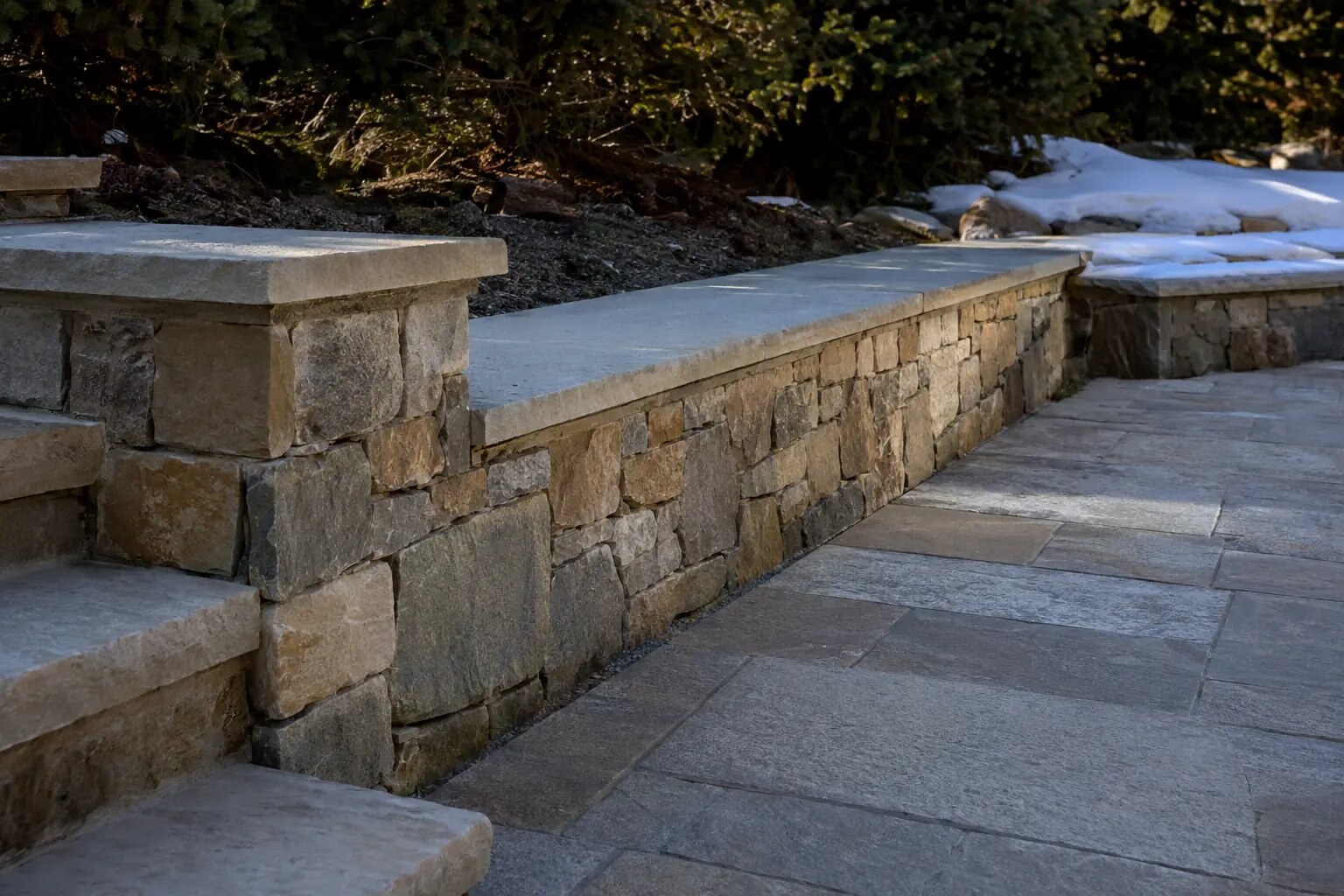
Step 3 · Inspect the assembly
Stone variation, joint pattern, cap geometry, and transitions.
Backing or support, anchorage or bond, drainage, and movement accommodation.
Source-specific test data, exposure suitability, mockup, and compatible adjoining materials.
Step 4 · Owner decision checklist
Use these finding-and-question pairings during design, submittal review, mockups, installation, and closeout.
Stone type alone does not establish exterior suitability; source-specific properties and test data matter.
Ask the teamWhat source-specific absorption, density, and durability documentation is available?
Water management behind, beneath, and at transitions is a system decision—not a surface-detail decision.
Ask the teamWhere does bulk water drain, and how are horizontal surfaces protected?
Joint geometry, movement accommodation, and compatible mortar or setting materials should be resolved with the assembly.
Ask the teamWhich movement and dissimilar-material interfaces require deliberate joints or separation?
Step 5 · Evidence and limits
Source credit identifies the research record. Contractor-informed Registry interpretation connects those principles to owner questions; it does not imply agency authorship, endorsement, product approval, or a parcel-specific conclusion.
The project team must still confirm the actual product, source, testing, exposure, substrate, fasteners or anchors, adjacent materials, installation instructions, mockups, warranties, maintenance, and local requirements.
Read the Registry methodology →