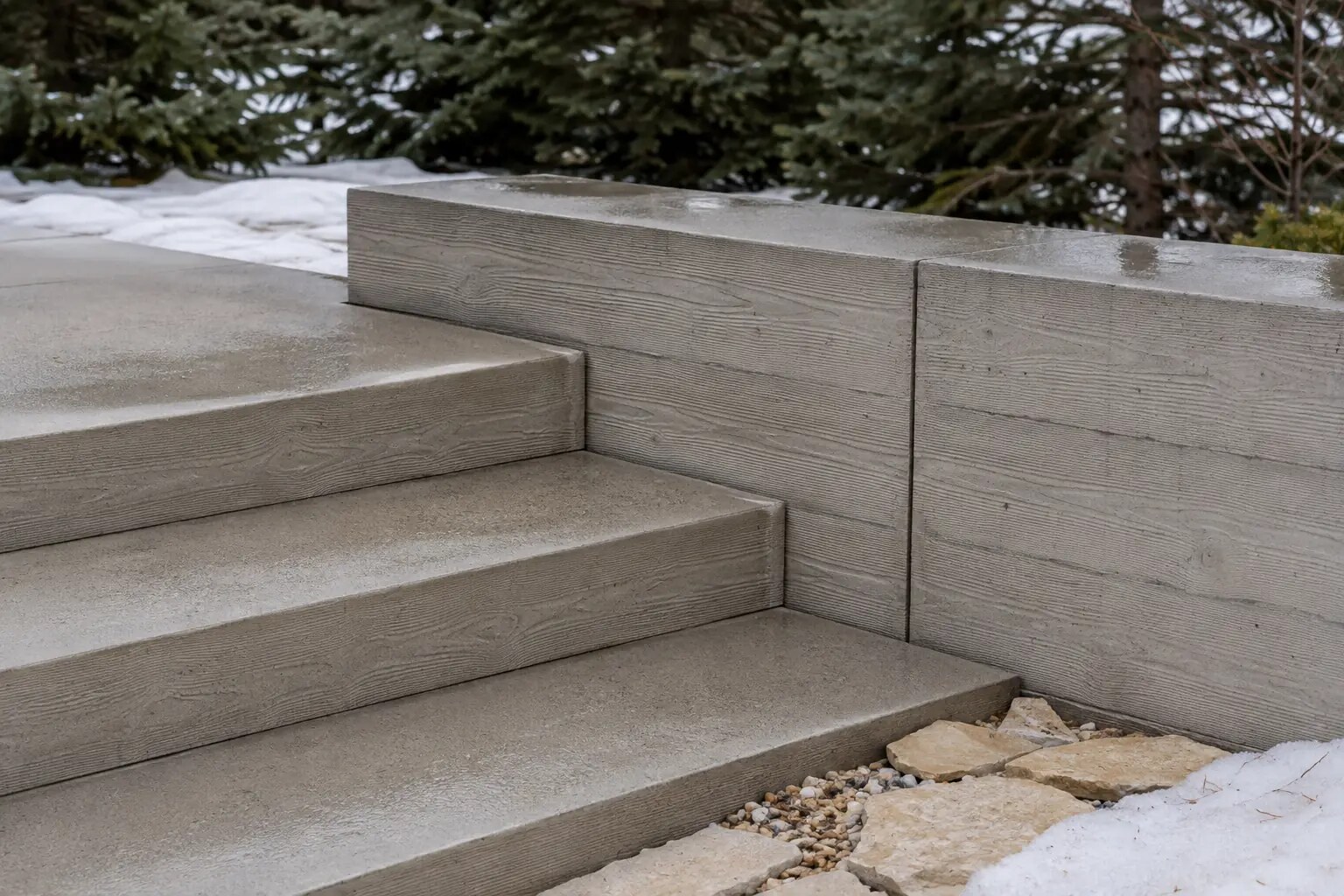
Board-formed cast-in-place
Structure and finish are created together. Review mixture, formwork, tie pattern, placement, curing, joints, and acceptable variation.
Open Board-formed cast-in-place profile →Installed-system planning record
Durability begins with exposure classification, mixture design, consolidation, curing, drainage, joints, and protection—not the final color or texture.
The complete installed system for this category—not the individual examples and not appearance alone. The review includes the visible material, support or substrate, joints, attachment, drainage, transitions, installation, and upkeep.
Step 1 · Compare examples
These are generic illustrative specimens for visual orientation. Color, grain, aggregate, finish, weathering, and performance vary by source and product; approve the actual sample and technical data.
Want the five-point profiles? Open one specific material below. Those scores show specification attention for that named material only; they are not a quality or durability grade.

Structure and finish are created together. Review mixture, formwork, tie pattern, placement, curing, joints, and acceptable variation.
Open Board-formed cast-in-place profile →Factory casting can improve control, but panel engineering, anchors, transport, joints, patching, and erection tolerances remain central.
Open Sandblasted precast profile →A refined exposed-aggregate finish needs an approved mockup, consistent production, protected edges, deliberate joints, and a cleaning plan.
Open Honed precast profile →Useful for lighter architectural forms. Confirm engineering, attachment, backing, edges, joints, color range, and exterior exposure requirements.
Open GFRC accents profile →Decision comparisons
Use these owner-side comparisons to test specification tradeoffs, exposure, maintenance, and replacement strategy before a product or assembly is committed.
Step 2 · Whole-system concerns
These concern levels apply to the complete installed system across the examples above. They are planning priorities—not scores for an individual material, product, supplier, or workmanship. Use the specific material profiles above for the separate five-point layer.
Moisture, air-void structure, aggregate, saturation, placement, and curing all affect freeze–thaw durability.
Chlorides and deicers can accelerate scaling and reinforcement corrosion, especially where water lingers.
Moisture is central to common deterioration mechanisms and must be managed through slope, joints, and drainage.
Joint layout, restraint, geometry, and temperature cycling influence cracking and interface performance.
Step 3 · Inspect the assembly
Form pattern, color range, edges, joints, slope, and surface drainage.
Mixture, air system, reinforcement cover, substrate, curing, and water path.
Exposure class, placement plan, approved mockup, curing record, and crack expectations.
Step 4 · Owner decision checklist
Use these finding-and-question pairings during design, submittal review, mockups, installation, and closeout.
Freeze–thaw durability depends on the complete concrete system, including air-void structure and saturation exposure.
Ask the teamWhat exposure conditions govern the mixture and reinforcement protection?
Deicing chemicals can intensify scaling and corrosion risks when water and chlorides reach vulnerable concrete and reinforcement.
Ask the teamHow will water leave steps, walls, copings, decks, and equipment pads?
Curing, joint planning, drainage, and placement conditions materially influence service life and appearance.
Ask the teamWhere are cracking, movement, color variation, and mockup acceptance addressed?
Step 5 · Evidence and limits
Source credit identifies the research record. Contractor-informed Registry interpretation connects those principles to owner questions; it does not imply agency authorship, endorsement, product approval, or a parcel-specific conclusion.
The project team must still confirm the actual product, source, testing, exposure, substrate, fasteners or anchors, adjacent materials, installation instructions, mockups, warranties, maintenance, and local requirements.
Read the Registry methodology →