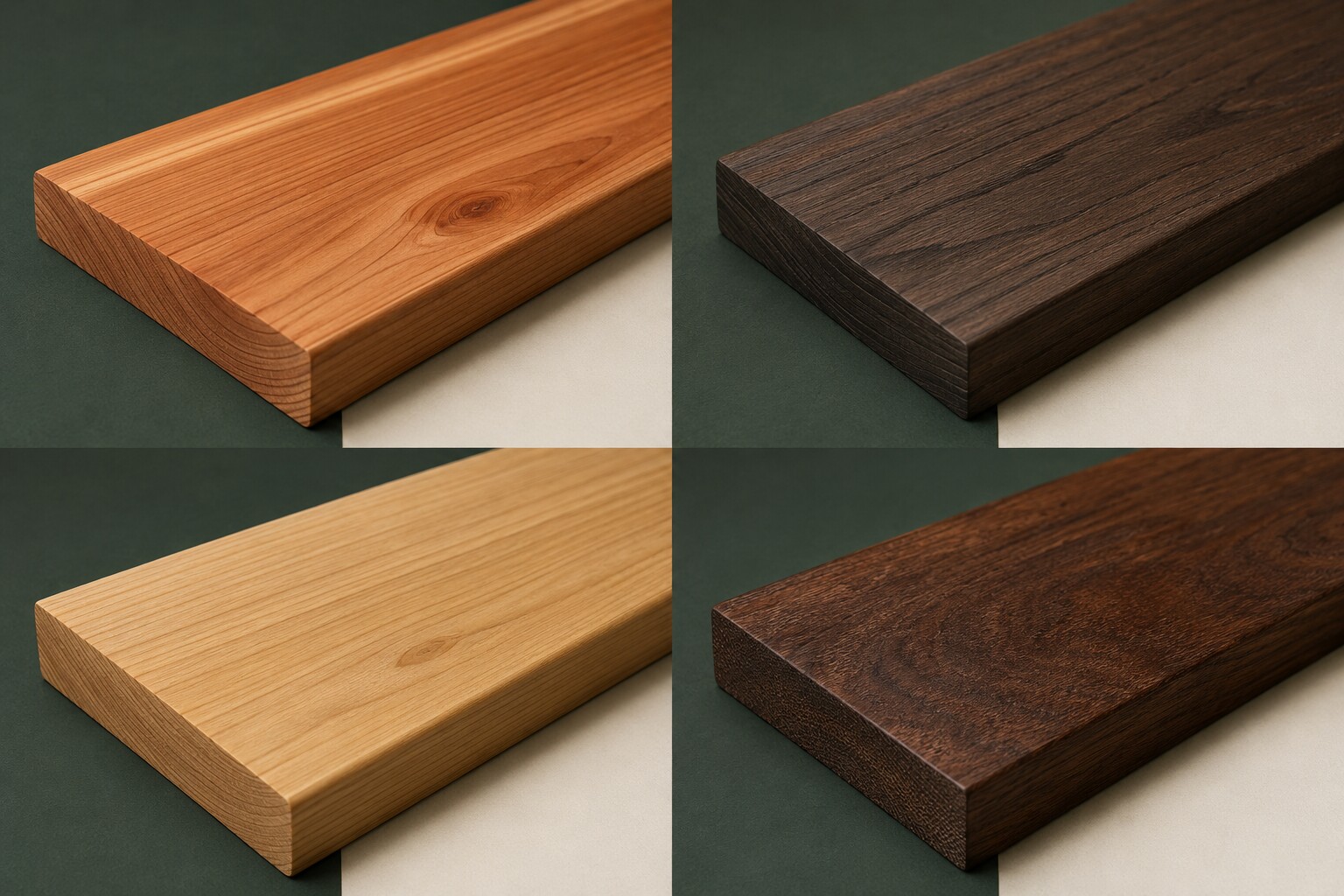
Is Thermally Modified Wood a Good Choice for Colorado?
Heat treatment can improve dimensional stability and decay resistance, while product instructions, fastening, brittleness, UV change, and sourcing remain important.
Material category
Exterior timber & wood finishes
Common exterior uses
Siding, screens, ceilings, decking, cladding, soffits, and architectural millwork.
What is scored
Specification attention for this named material type—not quality, beauty, durability, or a particular product.
Illustrative Thermally modified wood study—not a named product, quarry, mill, approved finish, test specimen, or installed project.Direct answer
Thermally modified wood can be a strong Colorado choice for decking, siding, screens, ceilings, and soffits when the exact product is approved for the application and installed as a drained, ventilated, manufacturer-compliant system. Its dimensional stability and decay resistance do not eliminate the need for stainless fasteners, moisture management, careful edge fabrication, UV expectations, wildfire review, and a realistic maintenance plan.
01
What are the main advantages of thermally modified wood?
Heat treatment can improve dimensional stability and resistance to biological decay without turning the material into a maintenance-free product. For estate work, the practical advantages are a refined real-wood appearance, product lines suited to several exterior uses, and potentially reduced moisture-related movement compared with untreated versions of the same species.
Where does it work well?
Common applications include ventilated cladding, screens, soffits, ceilings, and product-approved decking. The exact species, profile, treatment, thickness, support spacing, and warranty must match the use.
What does modification not solve?
It does not solve trapped water, missing ventilation, poor flashing, unsuitable supports, unapproved fasteners, standing snowmelt, wildfire constraints, or an owner’s expectation that the original brown color will remain unchanged without maintenance.
02
What are the disadvantages in Colorado exterior use?
The most important tradeoffs are product-specific fastening and fabrication rules, potential brittleness at edges and ends, unavoidable UV color change, ventilation requirements, possible tannin runoff, and a supply chain that may make future matching more difficult than common cedar.
Can it crack, cup, or stain?
Yes. Thermal modification can reduce movement but cannot prevent every natural-wood response. Manufacturer guidance connects common cupping or crowning problems to moisture imbalance and inadequate ventilation, and warns that incompatible fasteners can create black staining.
Is it appropriate next to pale stone or stucco?
It can be, but runoff and early weathering should be tested and detailed. Manufacturer literature notes that natural color can bleed from boards and become more visible on light adjacent surfaces.
03
How should thermally modified decking be detailed?
Follow the selected manufacturer’s current installation guide rather than a generic wood detail. For the Thermory guide reviewed here, key requirements include support spacing, product-specific gaps or clips, predrilling near ends, unobstructed sub-ventilation, positive drainage, and stainless-steel fastening.
Why are ventilation and drainage critical?
Unequal moisture above and below boards can drive cupping. The reviewed guide calls for continuous air movement under decking, prohibits direct ground installation, and requires drainage so water does not pool beneath the assembly.
Why do fasteners need special attention?
The reviewed manufacturer requires stainless-steel fasteners and warns that the higher acidity of its modified wood can rapidly corrode non-stainless screws and leave black staining. Edge distances, clip systems, and predrilling remain product-specific.
04
What will thermally modified wood look like after one and five years?
Exposure drives appearance. Unprotected boards begin changing immediately and can move toward a silver-gray patina; horizontal decking generally changes faster than protected soffits or vertical cladding. After five years, the result depends on sun, water, oxygen, exposure orientation, cleaning, coating choice, and maintenance history—not thermal modification alone.
Can the original brown color be preserved?
A compatible pigmented penetrating finish can slow UV change, but no exterior wood finish stops weathering permanently. Approve both a maintained-color sample and a naturally weathered sample before selecting the appearance path.
What maintenance should the owner expect?
Keep surfaces free of moisture-holding debris, follow the product’s cleaning instructions, inspect fasteners and drainage, and renew the approved finish based on actual exposure rather than an optimistic universal interval.
05
How does thermally modified wood compare with cedar and acetylated wood?
All three can create refined exterior work, but they are not interchangeable. Cedar relies on its natural species properties and grade; thermally modified wood changes wood through controlled heat; acetylated wood uses a chemical modification process. Compare exact products, approved uses, fastening, coating, warranty, supply, weathering, wildfire context, and replacement strategy—not category names alone.
When might cedar be the better decision?
Cedar may offer familiar fabrication, broader regional trade experience, easier replacement, and a well-understood weathering path when the selected grade and detailing fit the application.
When might acetylated wood be the better decision?
An acetylated product may be preferable when its exact warranty, dimensions, fabrication rules, coating system, and approved use align more clearly with the project. The decision still remains product- and assembly-specific.
How the five-point scale works
Higher means more confirmation—not better material.
The Registry uses this scale to show how much project-specific specification attention a factor deserves for Thermally modified wood. It is an editorial planning framework, not a laboratory result or product certification. No factors are averaged into an overall grade.
Levels are assigned from two questions: how consequential an unresolved factor could be, and how specific the evidence must be before commitment. They do not predict service life or failure.
1Limited
Confirm the standard submittal and installation requirements.
2Secondary
Review the factor, but it is unlikely to control the decision by itself.
3Material
Give the factor explicit project-specific specification attention.
4High
Resolve the factor before approval because it can materially affect the result.
5Critical
Require source-, product-, exposure-, or assembly-specific confirmation before commitment.
Specification-attention profile
What deserves attention for Thermally modified wood.
Every score below belongs to the named factor for Thermally modified wood. It does not describe the other examples in exterior timber & wood finishes.
5/ 5
Critical attention
Product-specific instructions
Registry rationale
Species, treatment process, profile, warranty, and approved use vary by producer.
4/ 5
High attention
Fastening and fabrication
Registry rationale
Modified material can require special predrilling, spacing, edge distances, and handling.
4/ 5
High attention
Moisture detailing
Registry rationale
Modification does not replace drainage, ventilation, flashing, and separation from persistent wetting.
4/ 5
High attention
UV and finish
Registry rationale
Color changes without maintained protection; coating compatibility and owner expectations should be explicit.
Before approval
Verify the actual selection.
Producer, species, treatment, profile, and approved exterior use
Fastener, predrilling, spacing, and handling instructions
Ventilation, flashing, end, and splash details
Coating compatibility, weathering sample, and warranty terms
Owner questions
Ask the project team.
Which exact product instructions govern this application?
How will brittle edges and fasteners be handled?
What appearance should the owner expect after one and five years?
Direct owner answers
Frequently asked questions.
Does thermally modified wood turn gray?
Yes. Like other real wood, it changes under UV exposure. It may weather toward silver-gray unless a compatible pigmented finish is maintained; decking generally changes faster than protected soffits or some cladding.
Can thermally modified wood be used around a pool?
It may be suitable when the exact decking product is approved for the use and the design provides positive drainage, ventilation, appropriate slip and barefoot considerations, compatible fasteners, and a maintenance plan. Do not assume every profile is pool-deck approved.
Does thermally modified wood need stainless-steel fasteners?
Follow the selected product instructions. The Thermory guides reviewed by the Registry require stainless-steel fasteners and warn that non-stainless screws can corrode and create black staining.
Is thermally modified wood maintenance-free?
No. It still needs cleaning, drainage and ventilation inspections, finish decisions, and replacement planning. Thermal modification does not eliminate weathering or poor-detail risk.
Apply the material decision
Connect the specification to the property and capital plan.
These sources support the broader material-system principles. The five-point values are contractor-informed Registry editorial judgments under the published rubric; the sources do not assign those numbers. Current manufacturer literature, project specifications, source-specific test data, and local requirements must govern the actual selection.